
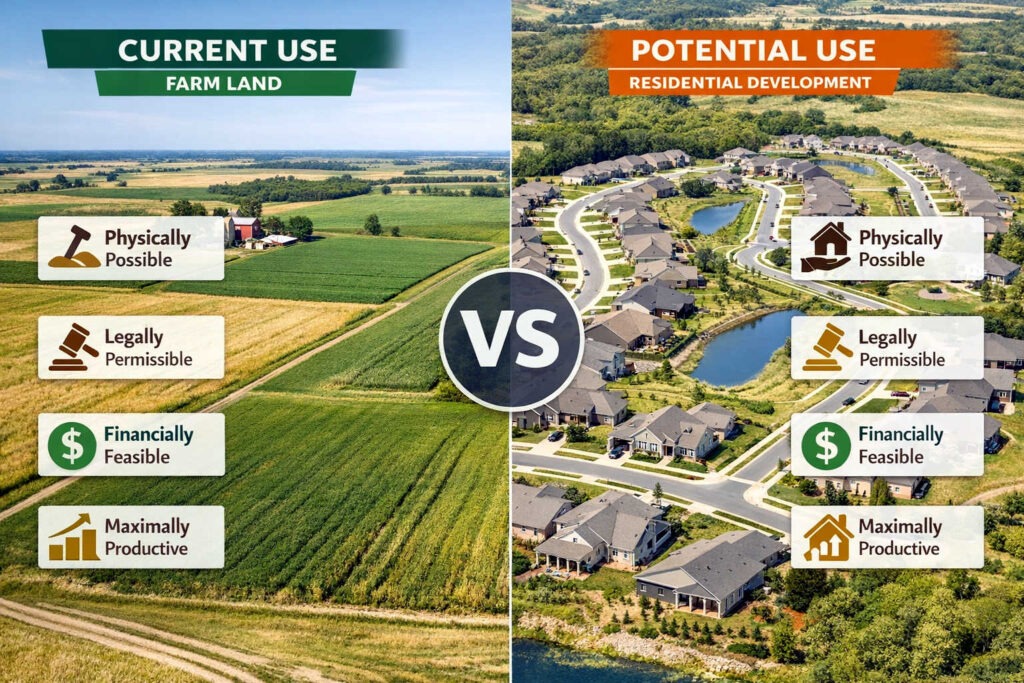
When evaluating land, one concept stands above the rest in determining value, opportunity, and long-term potential: highest and best use analysis.
At its core, this analysis answers a critical question:
👉 What is the most profitable and productive use of this land—now or in the future?
For buyers, this means identifying hidden upside. For sellers, it means positioning a property to capture its full market value. Whether you’re looking at farmland, ranchland, or property on the edge of a growing town, understanding highest and best use can completely change how you view a piece of land—especially when browsing farm land for sale in competitive markets.
What Is Highest and Best Use in Real Estate?
Highest and best use refers to:
The most reasonably probable use of a property that results in the highest value.
It’s important to understand that highest and best use is not always the current use.
A property might:
- Be used as pasture today
- But have significantly greater value as residential development
Or:
- Operate as dryland farming
- But become far more valuable with irrigation improvements
👉 The difference between what land is and what it could be is where opportunity—and profit—lives.
What Is a Highest and Best Use Analysis?
A highest and best use analysis is the structured process used to determine that optimal use.
Rather than guessing, this analysis evaluates the land through a combination of:
- Physical characteristics
- Legal constraints
- Financial feasibility
- Market demand
The goal is simple:
👉 Identify the use that produces the maximum value while remaining realistic and achievable
This process is used by:
- Land brokers
- Appraisers
- Investors
- Developers
And it plays a major role in both buying decisions and pricing strategy.
The 4 Tests Used in a Highest and Best Use Analysis
To qualify as the highest and best use, a potential land use must pass four key tests.
1. Physically Possible
What can the land realistically support?
This includes:
- Soil quality
- Topography
- Access (roads, utilities, water)
- Climate and drainage
👉 Example:
Flat, fertile ground with access to water may support row crop production, while rough or heavily wooded terrain may be better suited for grazing or recreation.
2. Legally Permissible
What is allowed under current regulations?
This includes:
- Zoning laws
- Deed restrictions
- Environmental regulations
👉 Example:
Even if land is ideal for commercial development, zoning may restrict it to agricultural use unless rezoning is approved.
3. Financially Feasible
Will the use generate a return?
This involves:
- Acquisition cost
- Development expenses
- Market demand
- Comparable sales
👉 Example:
Subdividing land into residential lots may be physically possible—but not financially feasible without strong local demand.
4. Maximally Productive
Which use creates the highest value?
This is the final step, where all factors come together.
👉 Example:
If land can be used for:
- Grazing ($2,000/acre value)
- Irrigated farming ($6,000/acre value)
Then irrigated farming would be considered the highest and best use.
Real-World Examples of Highest and Best Use in Land
Understanding theory is one thing—seeing it applied is where it becomes powerful.
🌾 Agricultural Land
- Current Use: Dryland farming
- Potential Use: Irrigated farming
- Key Driver: Water access and soil quality
👉 Adding irrigation can significantly increase yield—and land value, especially when evaluating Nebraska farm land for sale or similar agricultural markets.
🌱 Transitional Land (Path of Growth)
- Current Use: Pasture or farmland
- Potential Use: Residential or commercial development
- Key Driver: Nearby city expansion
👉 This type of land often sees the biggest jumps in value over time.
🦌 Recreational Land
- Current Use: Hunting property
- Potential Use: Cabin sites or short-term rentals
- Key Driver: Location, access, and natural features
👉 Value can increase when land supports multiple income streams.
Why Highest and Best Use Analysis Matters
A highest and best use analysis isn’t just theoretical—it directly impacts real-world decisions.
💰 Determines Property Value
Land is valued based on its potential, not just its current use.
📈 Guides Investment Decisions
Buyers can identify:
- Undervalued properties
- Future development opportunities
- Land with hidden upside
🏷️ Improves Pricing Strategy
Sellers who understand highest and best use can:
- Price more accurately
- Market more effectively
- Attract the right buyers
🧲 Strengthens Land Marketing
Listings that clearly communicate potential uses:
- Generate more interest
- Appeal to investors and developers
- Stand out in competitive markets
How to Perform a Highest and Best Use Analysis
While professional appraisals provide the most reliable results, buyers and sellers can begin evaluating land by following a structured approach.
Step 1: Evaluate Physical Characteristics
- Review soil maps, topography, and access
- Conduct a land survey if needed
Step 2: Verify Legal Constraints
- Check zoning regulations
- Review deed restrictions and easements
- Understand environmental limitations
Step 3: Analyze Financial Feasibility
- Estimate development costs
- Compare with market values
- Review comparable land sales
Step 4: Compare Potential Uses
- Identify multiple possible uses
- Determine which produces the highest return
Can You Do a Highest and Best Use Analysis Yourself?
Yes—but it requires time, research, and local knowledge.
Successful land buyers and sellers often rely on:
- Experienced land brokers
- Appraisers
- Local planning authorities
👉 This ensures decisions are based on accurate data rather than assumptions
Final Thoughts: Look Beyond What the Land Is Today
One of the biggest mistakes in land real estate is evaluating property based only on its current use.
The real opportunity lies in asking:
👉 What could this land become?
A well-executed highest and best use analysis allows you to:
- Make smarter investments
- Maximize property value
- Identify opportunities others overlook
Whether you’re buying, selling, or simply evaluating land, understanding highest and best use gives you a clear advantage in the market.