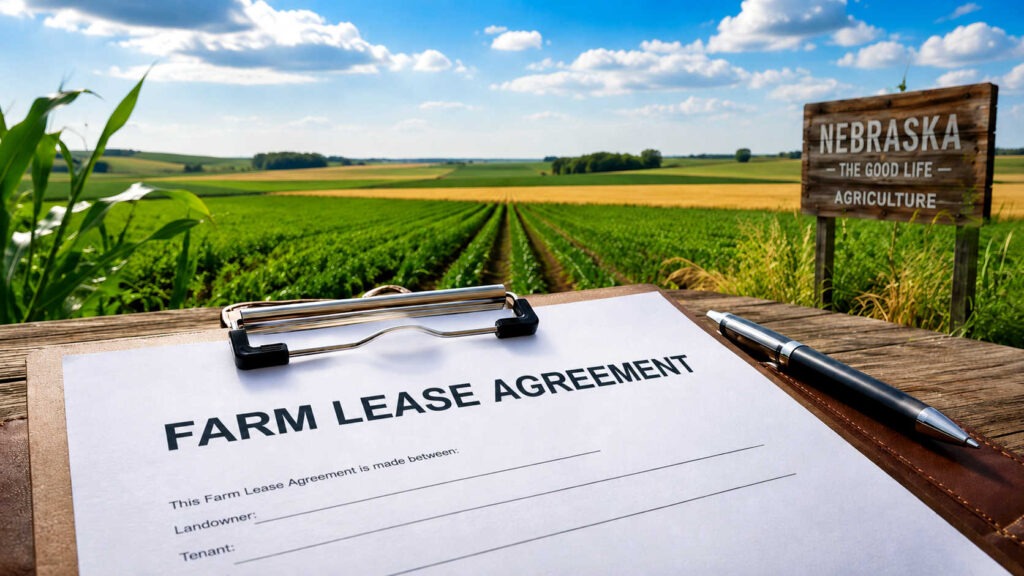
For many Nebraska landowners, leasing farmland is a practical way to keep productive acres in use while generating income from the property. Cash rent farmland in Nebraska is especially common because it gives landowners a predictable payment structure and gives farm operators access to cropland, pasture, or irrigated acres without purchasing the land outright.
Still, farmland leasing is not something landowners should approach casually. Lease rates can vary widely depending on soil quality, irrigation, crop history, pasture condition, location, market demand, and the overall productivity of the land. A fair lease should protect the landowner, give the tenant clear expectations, and preserve the long-term value of the property.
Whether you are researching Nebraska farmland lease rates, wondering how much to lease farmland in Nebraska, or comparing leasing with selling, understanding the basics can help you make a more informed decision.
How Much Does It Cost to Lease Farmland in Nebraska?
There is no single flat rate for leasing farmland in Nebraska. The cost depends on the property, the county, the quality of the acres, and the type of lease being used. Irrigated cropland, dryland farms, pasture land, and mixed-use agricultural properties can all lease differently.
When people ask how much to lease farmland in Nebraska, they are usually asking about one of three things:
Cash rent per acre
Crop share arrangements
Pasture or grazing lease rates
Cash rent is often the easiest structure to understand because the tenant pays the landowner a fixed amount, usually based on the number of acres included in the lease. Crop share leases divide the crop or crop income between the landowner and tenant. Pasture leases may be based on acres, animal units, grazing season, water access, or carrying capacity.
Because every farm is different, landowners should avoid relying on one generic statewide number. Instead, lease rates should be reviewed based on the property’s income potential, local market conditions, and the responsibilities assigned to each party.
What Affects Nebraska Farmland Lease Rates?
Nebraska farmland lease rates are influenced by several factors. Some are tied to the property itself, while others are connected to broader agricultural markets.
Soil quality is one of the biggest factors. Productive soils with strong yield history generally support higher lease rates than lower-producing acres. Irrigation can also make a major difference, especially in areas where water access improves consistency and crop potential.
Location matters as well. Farms located near strong local operators, grain facilities, livestock operations, or competitive agricultural markets may attract more tenant interest. Field size, access, shape, drainage, fencing, and overall condition can also affect what a tenant is willing to pay.
Commodity prices, input costs, interest rates, and weather patterns can influence lease negotiations from year to year. When crop prices are strong, tenants may be more comfortable paying higher rents. When margins tighten, lease rates may need to be reviewed more carefully.
Understanding Cash Rent Farmland in Nebraska
Cash rent farmland in Nebraska is popular because it is simple and predictable. The landowner receives a set payment, and the tenant generally takes responsibility for production decisions, crop inputs, and operating risk.
For landowners, a cash rent lease can provide steady annual income without requiring active involvement in day-to-day farming. For tenants, it allows more control over crop rotation, seed selection, fertilizer use, marketing decisions, and management practices.
However, the simplicity of cash rent can also create challenges. If the rent is set too low, the landowner may not receive fair market value. If the rent is set too high, the tenant may struggle to operate profitably, especially during years with lower yields or weaker commodity prices.
A good cash rent arrangement should balance the needs of both parties. The goal is not just to get the highest possible rent, but to create an agreement that protects the land, supports responsible management, and makes sense for the property.
Average Cash Rent in Nebraska Can Vary by Property Type
The average cash rent in Nebraska can change significantly depending on whether the land is irrigated cropland, dryland cropland, pasture, hay ground, or mixed-use agricultural land.
Irrigated farmland for sale often commands higher rental rates because it can offer stronger production potential and more yield consistency. However, it may also involve additional expenses related to wells, pivots, pumps, fuel, electricity, maintenance, and water management.
Dryland farms usually depend more heavily on rainfall, soil condition, crop rotation, and conservation practices. These acres may lease at a lower rate than irrigated farmland, but the right dryland farm can still be highly productive and valuable.
Pasture land for sale is different from cropland. Lease value may depend on grazing capacity, water access, fence condition, forage quality, location, and the length of the grazing season. A pasture lease should account for how many livestock the land can responsibly support without damaging long-term grass health.
Because these property types are different, landowners should avoid comparing all acres the same way. A fair lease rate should reflect how the land is actually used.
Cash Rent vs. Crop Share Leases
Cash rent and crop share leases are two of the most common farmland lease structures in Nebraska.
A cash rent lease gives the landowner a fixed payment. This makes income easier to predict, but the landowner typically does not share in the upside if yields or crop prices are especially strong. The tenant usually carries most of the production risk.
A crop share lease divides the crop or crop income between the landowner and tenant. In some arrangements, the landowner may also share certain input costs. This can allow the landowner to benefit when production is strong, but it may also create more income variability.
Crop share leases often require more communication and recordkeeping. Both parties need to understand how expenses, crop sales, storage, insurance, marketing, and production records will be handled.
Some landowners also use flexible cash leases. These agreements may start with a base rent and then adjust based on yield, crop prices, revenue, or another formula. A flexible lease can help balance risk, but the formula should be written clearly so both sides understand how final rent is calculated.
What to Include in a Nebraska Cash Rent Farm Lease
A Nebraska cash rent farm lease should be written clearly and reviewed carefully before the lease begins. Even when a landowner and tenant have a strong relationship, a written lease helps reduce confusion.
Important lease terms may include:
Lease start and end dates
Legal description of the property
Number of acres included
Cash rent amount
Payment due dates
Renewal terms
Termination requirements
Crop production expectations
Irrigation equipment responsibilities
Fence, road, gate, and access maintenance
Weed control expectations
Fertilizer, seed, and chemical responsibilities
Conservation practices
Pasture or grazing terms, if applicable
Hunting, recreational, or third-party access rights
Insurance requirements
Dispute resolution process
These details are especially important when the property includes more than one land type. A farm may include irrigated acres, dryland acres, pasture, hay ground, building sites, grain storage, or recreational areas. Each part of the property may need different lease language.
Verbal Leases vs. Written Leases in Nebraska
Many Nebraska farm leases still begin as verbal or handshake agreements. While those arrangements may work for a time, they can become difficult if ownership changes, a tenant relationship changes, rent needs to be adjusted, or the landowner decides to sell.
University of Nebraska–Lincoln Extension explains that terminating a verbal farmland lease in Nebraska generally requires notice by September 1 if the lease is to end the following February. For verbal year-to-year farm leases in Nebraska, the lease year generally runs from March 1 through the last day of February. University of Nebraska–Lincoln Extension explains that notice to terminate a verbal farmland lease must generally be given by September 1 if the lease is to end the following February.
That deadline can matter for landowners who are considering a sale, changing tenants, or renegotiating rent. If proper notice is not given in time, the lease may continue into the next lease year.
A written lease gives both parties more control because the agreement can define the lease term, payment schedule, renewal process, termination requirements, and property responsibilities.
Leasing Irrigated Farmland in Nebraska
Irrigated farmland often requires more detailed lease terms because the value of the land is closely tied to water access, irrigation equipment, and operating costs.
An irrigated farmland lease should explain who pays for irrigation energy, pivot repairs, pump maintenance, well upkeep, routine inspections, and system improvements. It should also clarify whether the tenant can make repairs or upgrades and how those costs will be handled.
Water use can also be affected by local rules, allocation limits, and conservation expectations. Because irrigation can strongly influence both productivity and land value, landowners should be clear about expectations before the lease begins.
For landowners comparing lease income with a possible sale, reviewing current irrigated farmland for sale can also provide useful market context.
Leasing Dryland Farms
Dryland farms have different lease considerations than irrigated farmland. Without irrigation, production depends more heavily on rainfall, soil type, residue management, crop rotation, and long-term conservation practices.
A dryland farm lease should address tillage, erosion control, terraces, waterways, fertilizer use, and crop rotation. Landowners may also want to include expectations for maintaining soil health and protecting the long-term productivity of the property.
Because dryland production can vary from year to year, some landowners and tenants may consider flexible rent structures. This can help account for changing yields, commodity prices, and weather conditions.
Leasing Pasture Land in Nebraska
Pasture leases are different from cropland leases because the value of the lease depends on grazing use rather than crop production. A strong pasture lease should address stocking rates, grazing season, water access, fence maintenance, gates, mineral placement, and pasture condition.
The lease should also explain who is responsible for livestock care, weed control, water systems, and damage caused by overgrazing. If the property includes ponds, tanks, windmills, pipelines, wells, or corrals, maintenance responsibilities should be clearly written into the agreement.
For landowners, protecting pasture condition is important. Poor grazing management can reduce carrying capacity, damage grass health, and affect future land value.
Nebraska Land for Lease vs. Land for Sale
Some landowners search for Nebraska land for lease because they want to understand what similar properties are renting for. Others may be trying to decide whether leasing or selling is the better long-term option.
Leasing can make sense when the landowner wants to keep the property, maintain annual income, and avoid selling an asset. This is common for retired producers, inherited farmland owners, families with long-term ownership goals, or landowners who want to hold the property for future generations.
Selling may make more sense when the land no longer fits the landowner’s financial goals, estate plan, family situation, or management preferences. Landowners who are comparing lease income with a possible sale can also review current Nebraska farm land for sale to better understand active market conditions. Some landowners choose to sell when land values are strong, when they want to simplify ownership, or when managing a lease has become difficult.
A lease can also affect a future sale. Buyers will want to know whether the land is leased, when the lease ends, whether the agreement is written or verbal, and when possession can transfer.
How Leasing Can Affect Land Value
A farmland lease can influence how buyers evaluate agricultural property. A stable lease with a strong tenant may show income history and demonstrate that the land has been productively managed. However, some buyers may want possession after closing, especially if they plan to farm the land themselves or place it with a different operator.
Lease terms can also affect timing. If a verbal lease has not been properly terminated or a written lease extends beyond the sale date, the buyer may have to honor the lease after closing.
This is why landowners should review lease agreements before listing farmland for sale. Rent amount, lease term, tenant rights, possession date, and termination requirements can all affect how the property is marketed and negotiated.
Should You Lease or Sell Nebraska Farmland?
There is no single right answer. Leasing and selling can both be good options depending on the landowner’s goals.
Leasing may be a better fit if you want ongoing income, wish to keep the land in the family, or are not ready to sell. It may also work well if you have a reliable tenant and a lease structure that protects the property.
Selling may be a better fit if you want to simplify ownership, settle an estate, reduce management responsibilities, or take advantage of strong buyer demand. A sale can also help landowners convert farmland equity into capital for retirement, investment, debt reduction, or family planning.
Before deciding, landowners should look at lease income, property condition, tax considerations, family goals, land value, and local market activity.
Final Thoughts on Nebraska Farmland Lease Rates
Nebraska farmland lease rates depend on more than acreage alone. Soil productivity, irrigation, pasture quality, location, tenant demand, crop history, and lease structure can all affect what is fair.
Cash rent farmland in Nebraska remains a common option because it gives landowners predictable income and gives tenants access to productive ground. However, the lease should be written clearly, reviewed regularly, and matched to the specific property.
If you own agricultural land in Nebraska, take time to understand your lease terms, compare your options, and consider whether leasing or selling best supports your long-term goals.
Ready to Take the Next Step?
AgWest Land Brokers helps landowners and buyers evaluate agricultural land across Nebraska. Whether you are thinking about leasing, buying, or selling farmland, our team can help you better understand the market and consider your next move.
To learn more, call 866-995-8067, send an email, or fill out the convenient web form.