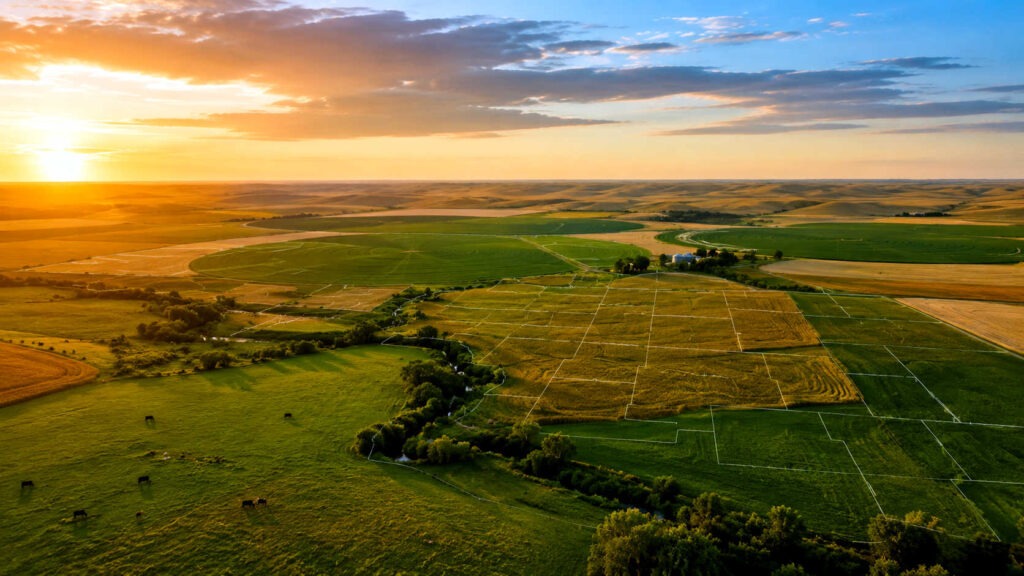
Nebraska land values by county can vary widely, even when properties appear similar at first glance. A productive irrigated farm in eastern Nebraska may command a very different price per acre than dryland farm land in the central or western part of the state. Pasture, grazing land, CRP acres, soil quality, water access, lease income, and nearby buyer demand all influence what a farm or ranch property may be worth.
For buyers and sellers, understanding Nebraska farm land prices requires more than looking at one statewide average. County-level land values are shaped by local conditions, including rainfall, irrigation availability, crop production history, access to grain markets, cattle demand, and comparable sales. That is why Nebraska agricultural land values should be reviewed through both a statewide market lens and a local county-level perspective.
According to the University of Nebraska–Lincoln’s 2026 Nebraska Farm Real Estate Market Survey, the statewide average market value of agricultural land declined by 1% from the prior year to approximately $3,905 per acre as of Feb. 1, 2026. UNL also notes that this was the second consecutive year Nebraska agricultural land values declined after reaching a record non-inflation-adjusted statewide value in 2024.
Why Nebraska Land Values Vary by County
Nebraska is a diverse agricultural state, and that diversity shows up clearly in land values. A county with highly productive soils, strong rainfall, and access to irrigation may see higher Nebraska farm land values than a county where the land is primarily used for pasture or dryland production.
Eastern Nebraska often benefits from stronger precipitation, productive cropland, and proximity to grain markets. Central Nebraska may include a mix of irrigated cropland, dryland acres, hayland, and pasture. Western Nebraska often relies more heavily on irrigation, grazing land, and livestock production. These regional differences help explain why Nebraska farmland prices are not uniform across the state.
Buyers and sellers can also compare county-specific resources, such as Hamilton County Nebraska farm land for sale and Phelps County Nebraska farm land for sale, to see how land types and local market factors differ by area.
County-level land values are commonly influenced by:
- Soil productivity and crop history
- Irrigation access and water reliability
- Dryland versus irrigated farm land
- Pasture and grazing demand
- Cash rent potential
- County-level comparable sales
- Commodity prices
- Input costs
- Interest rates
- Local operator and investor demand
For buyers, these differences affect long-term income potential and operating strategy. For sellers, they influence pricing, marketing, and how a property should be positioned to the right group of buyers.
Market Value vs. Assessed Value vs. Sale Price
When researching Nebraska land values by county, it is important to understand that “value” can mean different things.
Market value is what a property may reasonably sell for in the current real estate market. Assessed value is used for property tax purposes. Actual sale price is what a buyer and seller agree to in a specific transaction.
In Nebraska, agricultural and horticultural land is generally assessed at 75% of fair market value for property tax purposes, according to the Nebraska agricultural land assessment rules.
This distinction matters because someone searching for Nebraska agricultural land values may be looking for tax assessment information, while another person may be trying to determine what a farm could sell for today. Sellers should not rely only on assessed value when pricing a farm, and buyers should not assume that assessed value reflects the full market price.
Irrigated Farm Land Values in Nebraska
Irrigated farm land typically commands some of the strongest values in Nebraska because water access can improve yield consistency and reduce production risk. Center pivot irrigated cropland and gravity irrigated cropland are often evaluated separately because irrigation method, water source, pumping costs, and system condition all affect value.
The 2026 UNL report found that center pivot irrigated cropland averaged 2% lower statewide, while gravity irrigated cropland declined by an average of 3%. However, regional results varied, with some areas showing smaller declines or even slight increases depending on land class and location.
For buyers, irrigated acres may offer stronger production potential, but they also require careful due diligence. Water rights, well capacity, equipment condition, energy costs, and long-term Nebraska groundwater resources can all affect the true value of an irrigated farm
Current irrigated farmland for sale listings can also help buyers and sellers compare how irrigation infrastructure, acreage, and location influence active market opportunities.
Dryland Farm Land Prices in Nebraska
Dryland farm land is generally valued below irrigated cropland, but it remains an important part of Nebraska’s agricultural real estate market. Many producers and investors are drawn to dryland acres because they often involve lower equipment and operating costs than irrigated farms.
Dryland values are especially sensitive to rainfall patterns, soil quality, crop rotations, and yield history. A strong dryland farm in a reliable production area may still bring competitive interest, while land in more variable rainfall regions may price differently.
For sellers, this means the marketing strategy should clearly explain the property’s production history, tenant history, soil profile, and income potential. For buyers, it means the price per acre should be weighed against realistic crop expectations and long-term risk.
AgWest’s dryland farms listings provide additional context for buyers and sellers comparing non-irrigated cropland, soil productivity, acreage, and location.
Pasture, Grazing Land, and Ranch Values
Pasture and grazing land values are driven by a different set of factors than cropland. Carrying capacity, fencing, water access, grass condition, location, and livestock markets all play an important role.
In recent years, strength in the cattle market has helped support demand for Nebraska pasture and grazing acres. This has made ranchland and mixed-use agricultural properties especially important in counties where livestock production is a major part of the local economy.
Landowners and buyers evaluating grazing acres can also review pasture land for sale to compare fencing, water access, grass quality, carrying capacity, and mixed-use agricultural potential.
Nebraska pasture rental rates can also help buyers and sellers evaluate income potential. The USDA National Agricultural Statistics Service notes that its Cash Rents Survey provides county-level estimates for irrigated cropland, non-irrigated cropland, and pasture where sufficient acreage thresholds are met.
Cash Rent and Its Impact on Land Values
Cash rent is one of the most important indicators for evaluating Nebraska farm land prices. Land that can generate reliable rental income may be more attractive to investors, absentee owners, and operators looking to expand.
For readers comparing opportunities beyond one state, AgWest also features farm land for sale across key agricultural markets, including dryland farm land, irrigated farm land, pasture, and CRP land.
Cash rental rates vary by land type and location. Irrigated cropland generally rents for more than dryland cropland, while pasture rental rates are evaluated differently based on grazing capacity and livestock demand.
For landowners, lease structure matters. A fixed cash rent can provide predictable income, while a crop-share or flex lease may allow the landowner and tenant to share risk and reward. In a changing market, flexible lease terms can help both parties adjust to commodity prices, input costs, and yield conditions.
For a deeper look at lease structure and rental considerations, AgWest’s guide to cash rent farmland in Nebraska explains how lease rates, crop share agreements, pasture leases, and written lease terms can affect landowner decisions.
What Buyers Should Look At Before Purchasing Nebraska Farm Land
Buyers evaluating Nebraska land values by county should look beyond the listing price. A property’s true value depends on both the land itself and the income or utility it can provide.
Buyers who are actively comparing current opportunities can also review available Nebraska farm land for sale to see how land type, location, acreage, and property features compare across the market.
Important review items include soil productivity, irrigation access, crop history, lease agreements, water rights, fencing, county taxes, easements, access roads, conservation program enrollment, and comparable land sales. Buyers should also consider whether the property fits their goals, whether that means expanding an operation, investing in farm land, purchasing grazing acres, or holding agricultural real estate long term.
County-level insight is especially valuable because two farms in different counties may have very different buyer pools, land use patterns, and income expectations.
What Sellers Should Know Before Pricing Farm Land
Sellers should avoid pricing agricultural land based only on statewide averages. Nebraska farm land values can shift substantially from one county to another and from one land class to another.
A strong pricing strategy should consider recent comparable sales, the property’s land type, soil quality, irrigation, lease income, tenant history, improvements, access, and local buyer demand.
For county-level examples, sellers can review resources like Merrick County Nebraska farm land for sale and Sheridan County Nebraska land for sale to see how location, land type, and regional demand can shape property positioning.
It should also account for whether the land is best positioned as irrigated cropland, dryland farm land, pasture, CRP land, mixed-use agricultural land, or investment property.
The right marketing approach can make a major difference. Buyers want clear information, strong visuals, accurate property details, and a realistic explanation of the land’s agricultural potential.
The 2026 Outlook for Nebraska Agricultural Land Values
Nebraska agricultural land values appear to be stabilizing after several years of strong appreciation followed by modest declines. Lower commodity prices, elevated input costs, and higher interest rates have made buyers more cautious. At the same time, limited land supply, strong agricultural productivity, and long-term demand for food production continue to support the market.
For buyers, this creates opportunities to evaluate properties carefully and compare land values by county, land class, and income potential. For sellers, it reinforces the importance of accurate pricing and strong presentation.
Whether you are buying, selling, leasing, or evaluating long-term ownership options, Nebraska land values by county should be viewed through a local lens. Statewide averages are useful, but the details of each property often determine its real market value.
Frequently Asked Questions About Nebraska Land Values
How are Nebraska land values determined?
Nebraska land values are influenced by land type, soil productivity, irrigation access, crop history, pasture demand, cash rent potential, comparable sales, and local buyer demand.
Why do Nebraska land values vary by county?
Land values vary by county because each area has different soil quality, rainfall, irrigation access, crop production, livestock demand, infrastructure, and recent land sale activity.
Is assessed value the same as market value for Nebraska farm land?
No. Assessed value is used for property tax purposes, while market value reflects what a property may sell for in the current real estate market.
What types of farm land usually bring higher values in Nebraska?
Irrigated farm land often brings higher values because reliable water access can support stronger yield consistency and reduce production risk. Dryland farm land, pasture, grazing land, and CRP land are valued based on their own income potential and land-use factors.
Ready to Take the Next Step?
AgWest Land Brokers can help you buy or sell farm land, ranch land, pasture, dryland acres, irrigated farm land, and agricultural real estate across Nebraska. To see how we can help, call 866-995-8067, send an email, or fill out our convenient web form.